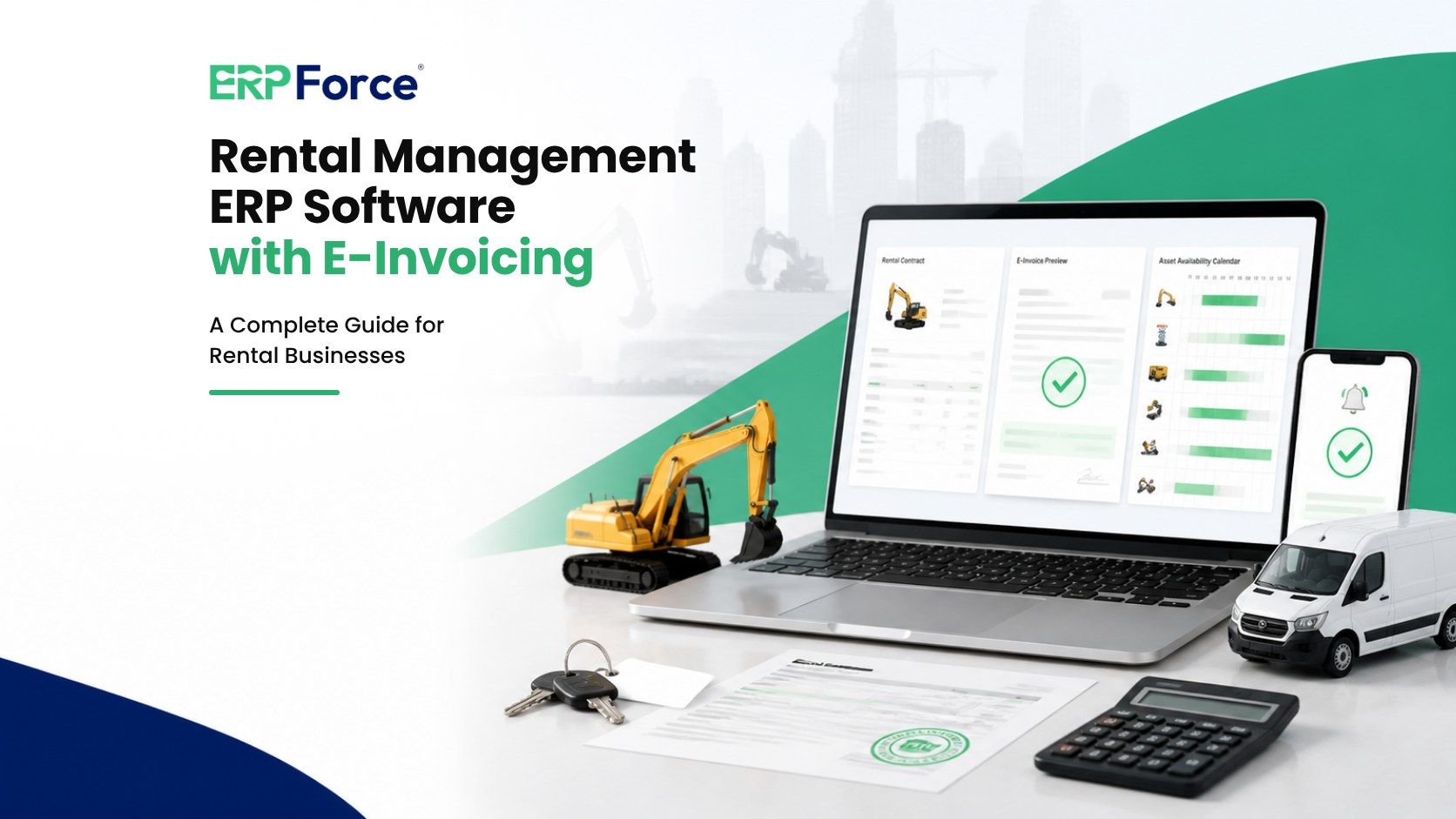
Rental Management ERP Software with E-Invoicing: A Complete Guide for Rental Businesses
Modern rental businesses operate in an environment that is constantly changing. Companies that deal with vehicles, equipment, scaffolding or other machinery must manage contracts, monitor payments and maintain compliance.
Errors become common when companies handle these tasks through spreadsheets or disconnected software. Billing delays, missed returns and inaccurate inventory records all affect profitability.
Rental management ERP software is the solution here. It centralizes operations and automates financial processes, and gives businesses real-time insight.
Why Rental Businesses Need a Specialized ERP System
Rental businesses have operational requirements that differ from traditional sales-based companies.
Instead of selling products outright, they manage assets that move between customers repeatedly. Here, every transaction involves rental duration, availability, deposits, maintenance and billing.
Without an integrated system, teams face many challenges:
- Double bookings or incorrect asset availability
- Manual invoice creation and delayed payments
- Difficulty tracking rental returns
- Poor coordination between sales, inventory and finance
- Lack of real-time visibility into equipment usage
A modern rental management ERP software helps solve these problems by connecting rental operations, accounting, and inventory in a single platform.
With automation and centralized data, teams gain complete control over assets, contracts, and financial transactions.
What Is Rental Management ERP Software
Rental management ERP software is an enterprise system designed specifically to manage rental operations.
It combines several business functions into one integrated platform.
These typically include:
- Rental contract management
- Asset tracking and availability monitoring
- Customer management
- Billing and invoicing
- Financial reporting
- Inventory control
- Logistics and delivery coordination
Instead of using multiple tools, businesses manage everything from one dashboard.This reduces manual work and improves operational accuracy.
Modern ERP platforms also offer AI-powered insights, automation and analytics to help businesses make better decisions.
Growing Importance of E-Invoicing in Rental Operations
Businesses around the world are increasingly focused on digital compliance. To ensure tax compliance and transparency, governments are introducing regulations that require electronic invoicing.
E-invoicing offers clear benefits for rental companies that generate frequent invoices.
Benefits include:
- Automated invoice generation
- Faster payment cycles
- Improved tax compliance
- Reduced manual errors
- Better financial record keeping
Instead of manually creating invoices, the ERP system generates compliant digital invoices directly from rental transactions.
This ensures accuracy and simplifies reporting for finance teams.
For rental companies that operate in regulated markets and integrated invoicing capabilities have now become an important feature.
Key Features You Need in Rental ERP Software
To choose the right ERP system, you need to understand which features support rental operations effectively. Here are the key capabilities to consider.
Asset and Inventory Tracking
Rental companies must always know where their assets are located.
ERP systems give real-time insight into asset availability, rental and maintenance schedules and asset utilization.
This helps avoid booking conflicts and improves operational planning
Rental Contract Management
Contracts define rental periods, deposit amounts, pricing and other terms.
An ERP platform centralizes contract data, and applies pricing rules and billing cycles.
This eliminates manual calculations and reduces the risk of contract errors.
Automated Billing and Invoicing
The billing process in rental businesses usually comes with complex calculations like hourly, daily, or monthly charges.
Robust rental management ERP software automates billing based on contract terms and asset usage.
Invoices are generated automatically, supporting accurate and timely payments
Logistics and Delivery Coordination
Many rental businesses manage deliveries and equipment pickups.
ERP systems integrate with logistics workflows to track delivery schedules, transport details, and return timelines.
This improves coordination between warehouse, customer service, and operations teams.
Financial Management and Reporting
ERP platforms integrate rental transactions directly with accounting systems.
This lets businesses track revenue, expenses, taxes, and profitability - all in real time.
Advanced dashboards also provide insights into asset utilization, rental trends, and financial performance.
How Rental ERP Software Benefits Growing Businesses
Implementing rental management ERP software offers several operational and financial advantages.
Improved Operational Efficiency
Automation reduces manual work across departments.
Rental bookings, asset allocation, billing, and reporting become faster and more accurate.
Better Asset Utilization
Rental companies rely on maximizing the use of their equipment.
ERP dashboards provide insights into asset performance, helping businesses optimize inventory and avoid idle equipment.
Real-Time Business Visibility
Managers can monitor operations through centralized dashboards.
Data from finance, inventory, and rental operations becomes instantly accessible for decision-making.
Reduced Errors and Manual Work
Manual spreadsheets increase the risk of billing mistakes and asset mismanagement.
ERP automation ensures consistent workflows and accurate record keeping.
Rental ERP Software in the UAE Market
The Middle East rental industry is witnessing rapid growth, particularly in infrastructure, construction, events and equipment leasing.
Digital tools that support compliance, multilingual operations, and tax regulations are essential for businesses that operate in the region.
A well-designed rental ERP software UAE solution typically supports:
- VAT-compliant invoicing
- Multi-currency transactions
- Scalable cloud deployment
- Integration with logistics and accounting systems
These capabilities let rental companies operate more efficiently and meet regulatory requirements.
How ERP Systems Support Business Scalability
In a scenario where rental companies expand, operational complexity increases.
More equipment, contracts, customers and financial transactions need to be managed simultaneously.
Growth can lead to operational bottlenecks without a system that is scalable.
A modern rental management ERP software provides the digital infrastructure needed to scale.
It allows businesses to:
- Manage multiple branches or warehouses
- Support larger asset inventories
- Automate workflows in departments
- Integrate with third-party platforms and payment gateways
Best Practices for Its Implementation
The rental companies must consider the following for implementation:
1. Evaluate Business Processes
You must understand current workflows and identify inefficiencies.
2. Define Key Requirements
List features needed for asset tracking, billing, logistics, and financial reporting.
3. Ensure Integration Capabilities
The ERP system should connect with existing tools such as CRM, accounting software, or payment gateways.
4. Train Teams Effectively
The successful ERP adoption is dependent on how well teams understand and use the system.
5. Begin with Scalable Architecture
You must get a platform that has the capability to grow with your business.
If you adhere to these best practices, you can make a smoother transition between manual and digital ERP systems.
Conclusion
Today, rental businesses need more than just basic inventory or inventory tools. These businesses require integrated platforms to manage assets, contracts and billing, as well as logistics, and financial reporting.
The modern rental management ERP software streamlines operations, increases asset utilization and helps maintain financial accuracy, while maintaining regulatory compliance.
The rental businesses that look for digitized operations and building a scalable system - ERPForce offer integrated ERP solutions to automate workflows and enable real-time insights. The business can explore their platform to modernize operations and bring growth for the long-term