Ask a business owner why they are looking for an ERP, and the answer is rarely, "We need more software." Usually, something is already becoming difficult to manage. Finance has one set of numbers, the warehouse has another, sales is maintaining its own records, and someone is still updating a spreadsheet to make sense of everything.
That is where ERP software starts to become useful. It brings those moving parts into one system, giving different teams access to the same business information.
For companies operating in the UAE, there also are local tax, accounting and operational necessities to consider. So, finding the best ERP software in UAE is actually about finding a system that works for the enterprise behind the numbers.
Quick answer
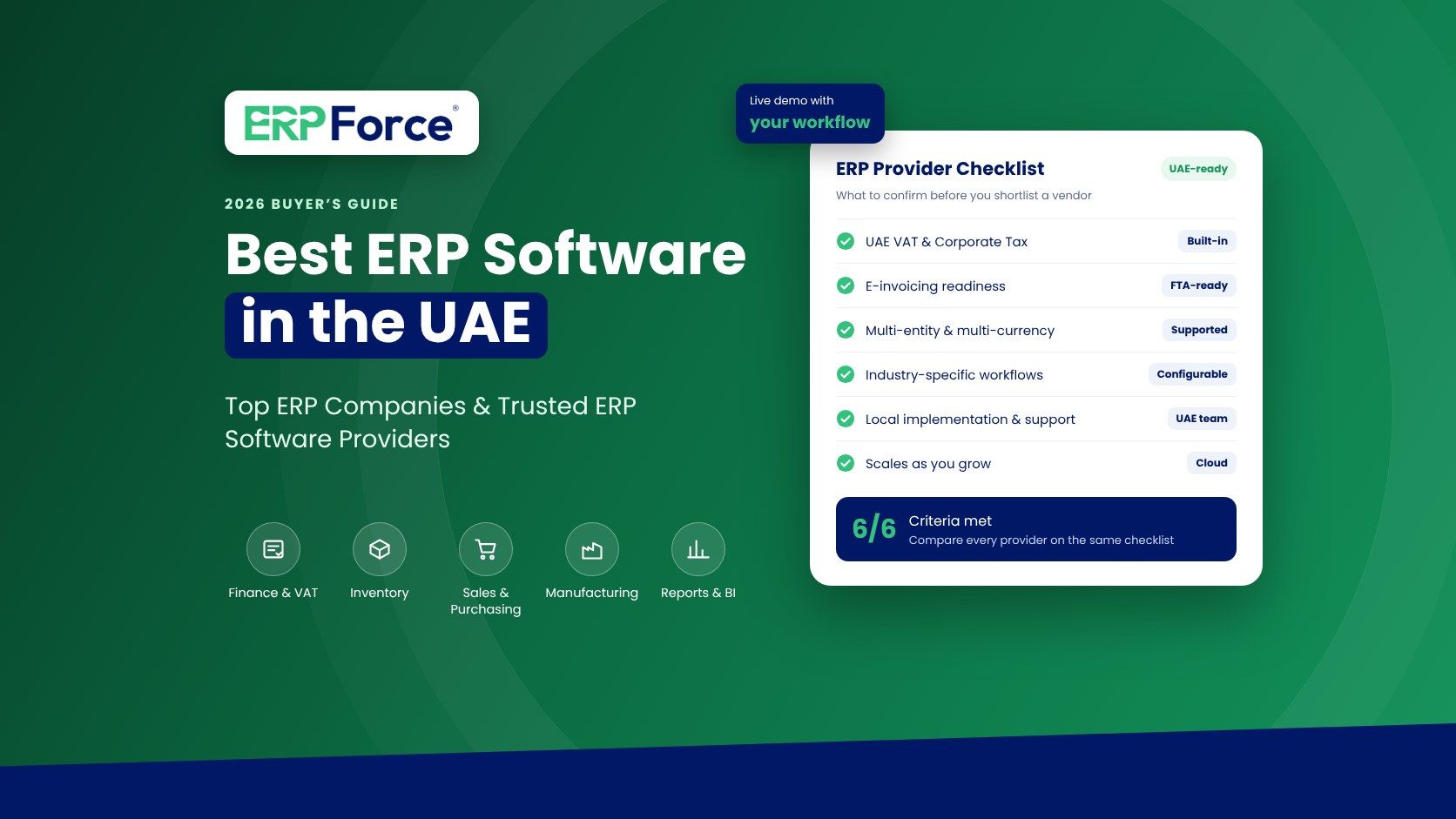
The best ERP software in UAE is the one that fits how your business actually works. It should connect sales, purchasing, inventory and accounts, support UAE VAT, Corporate Tax and e-invoicing, and scale to new warehouses, entities and currencies. Compare providers by giving each one the same real business scenario, and check implementation, data migration, training and support before you sign.
Key takeaways
- There is no universal best ERP; manufacturing, trading and service companies each have different priorities.
- Start with your own problems: duplicate data entry, slow reports, stock discrepancies and approvals done over email.
- Do not assume an ERP supports UAE VAT, Corporate Tax and e-invoicing; ask the vendor to show it.
- Choose a provider based on industry experience, migration process and post-launch support, not just modules.
- Count the full cost: licence, implementation, integrations, migration, training and ongoing support.

What Makes an ERP a Good Fit for a UAE Business?
There is no universal answer.
A manufacturing company might spend most of its time thinking about raw materials, production schedules, bills of materials and product costing. A trading company may be more concerned with purchase orders, stock levels, supplier deliveries and customer orders. A service company could have an entirely different set of priorities.
This is why a feature-by-feature comparison can be misleading.
Before looking at software, it helps to look at the business itself. Where is information being entered twice? Which reports take too long to prepare? Where do stock discrepancies appear? Which approvals are still handled through emails or spreadsheets?
Those answers give you a much better starting point for finding the best ERP software in UAE.
Important Things to Check Before Choosing an ERP
Does It Handle Your Day-to-Day Work?
An ERP should fit into the way your employees work rather than making ordinary tasks unnecessarily complicated.
Take a simple sales transaction. Ideally, an order should flow through inventory, delivery, invoicing and accounts without different teams having to recreate the same information.
The same applies to purchasing. A purchase request, approval, supplier order, goods receipt and invoice should be connected wherever the workflow requires it.
During a product demonstration, ask the vendor to show actual business scenarios. A generic tour of dashboards will tell you far less.
What About UAE Tax and Compliance Requirements?
For UAE companies, localisation matters.
VAT, tax invoices, accounting records, Corporate Tax-related requirements and the country's developing e-invoicing framework all need to be considered when evaluating an ERP.
It is worth asking specifically how these requirements are handled within the system. Do not assume that a platform will automatically support every local requirement simply because it is available in the UAE.
Will the System Still Work as the Company Grows?
An ERP can remain at the centre of a business for years. That makes future requirements worth considering before signing a contract.
Perhaps there will be another warehouse next year. Maybe a second legal entity will be added, or the company will start dealing in additional currencies. The system should have enough flexibility to accommodate such changes without turning every expansion into a separate software project.
Looking at ERP Software Companies in UAE
There are plenty of ERP software companies in UAE like ERPForce, including international vendors, regional technology companies and implementation specialists.
The difficult part is not finding a vendor. It is working out which one understands your requirements.
Two providers can offer similar modules but deliver very different experiences during implementation. One may have strong industry knowledge and a well-defined migration process, while another may rely heavily on customisation.
That difference tends to become visible after the contract is signed.
When shortlisting vendors, ask about previous implementations in your industry. Find out who will actually manage the project, how existing data will be transferred, what training is included and what happens when something goes wrong after launch.
Choosing Between ERP Software Providers in UAE
A useful way to compare ERP software providers in UAE is to give each one the same real-world problem.
For a distributor, that might mean showing how a purchase order becomes a warehouse receipt and eventually a customer invoice. For a manufacturer, it could involve a production order, material consumption, finished goods and costing.
Then look at how much manual intervention is required.
This approach can reveal a lot more because you are seeing the software in the context in which your business teams will actually use it.
Also, the subscription or licence is only one part of ERP expenditure. Implementation, integrations, data migration, training, customisation and ongoing support can all add to the final figure.
Finding an ERP That Fits the Business
There is a temptation to choose an ERP by counting modules. More modules must mean more value, right?
But, a company may never use half of the features it pays for, while one missing capability can create issues each day. The more useful question is whether the system can handle the work your teams actually do.
Rather, ask the finance team what slows them down. Speak to the warehouse team about stock movements. Ask sales where information gets lost between an enquiry and an order. Their answers can reveal more than a standard product presentation.
It is also worth taking your time with implementation discussions. Changing an ERP affects far more than the IT department. Data, processes and people all have to move together. A provider that understands this can make the transition considerably easier.
For businesses comparing the best ERP software in UAE, the final choice should therefore come down to practical fit. The software needs to handle today's workload, accommodate tomorrow's changes and give different teams a shared view of the business, like in ERPForce.
FAQs
1. How do I know whether an ERP is right for my company?
Start with the problems at hand. If your teams are repeatedly entering the same information, relying on spreadsheets for important processes or spending too much time preparing reports, an ERP may be worth considering. The next step is to see whether a shortlisted system can handle specific situations related to your business.
2. What should I look for when comparing ERP software companies in UAE?
Ask who will implement the system, not just who sells it. Find out whether the provider has worked with businesses similar to yours, how they handle existing data and what support looks like after the software goes live. These details can have a bigger impact on the project than a long list of features.
3. Are all ERP software providers in UAE offering the same thing?
No. Providers can differ considerably in the industries they serve, implementation experience, level of customisation, support structure and the platforms they work with. Two vendors could be offering similar software, but can still provide very different implementation experiences.
4. How long does it take to implement an ERP?
There is no actual fixed timeline for it. A relatively straightforward implementation may take much less time than a project involving several branches, warehouses, integrations or years of historical data. The number of users and amount of customisation also affect the schedule.
5. Should a growing UAE company invest in ERP now or later?
Waiting can make an ERP task harder due to the fact that processes get complicated as a business grows. If existing systems are already developing duplicate work and has minimised visibility, it is worth assessing ERP alternatives sooner as opposed to later. The crucial issue is selecting a system that matches the company's size and growth plans.
Last updated: 18 November 2026 · By the ERPForce Team